
Rolex raised gold prices about 5% on June 1. Steel didn't move.
The June 1, 2026 US list raises solid gold roughly 5% and two-tone as much as 6.7% while steel, platinum, and titanium hold. The second increase of the year moves trade-in math, not your watch's value.
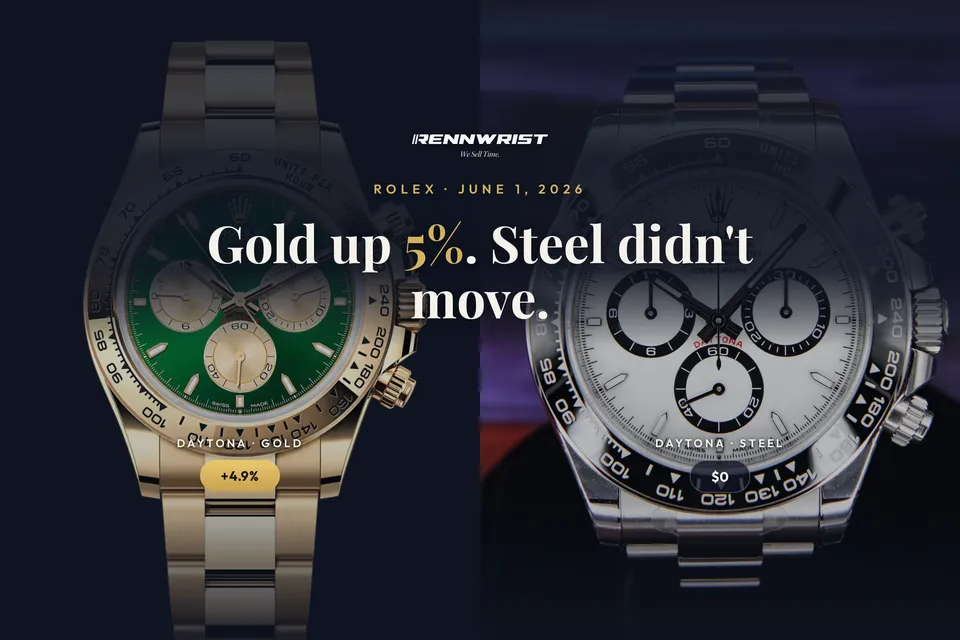
Quick answer: Rolex raised US retail on solid gold models roughly 5% and two-tone references as much as 6.7% on June 1, 2026. Steel, platinum, and titanium references did not change. It is the second increase of 2026, after a January 1 rise of 4% to 9% across the catalog.
A collector holding a gold Daytona did not get richer on June 1. Rolex repriced the benchmark, not the watch. The June 1, 2026 US list is the second increase this year, and it is narrow: solid gold up roughly 5%, two-tone up to 6.7%, with steel, platinum, and titanium models unchanged.
January 1 was the broad stroke. That increase ran 4% to 9% across the catalog and made it seven straight years of January rises. June reads as a gold-cost adjustment and nothing else.
What changed on June 1, 2026 and what didn't
The pattern in the list: steel $0, full gold about 5%, gold with a complication about 7%.
Daytona 126508, yellow gold: $52,600 to $55,200 (+4.9%)
Daytona 126505, Everose: $56,400 to $59,100 (+4.8%)
Day-Date 40 228238, yellow gold: $48,000 to $50,400 (+5.0%)
Sky-Dweller 336938, yellow gold: $57,200 to $61,400 (+7.3%)
Submariner 126613LB, two-tone: $18,400 to $19,450 (+5.7%)
Datejust 41 126331, two-tone Everose: $17,050 to $18,200 (+6.7%)
Daytona 126500LN, steel: $16,900, unchanged
The biggest dollar move is the Sky-Dweller: $4,200 on both the yellow gold 336938 and the Everose 336935. The steel sports catalog, where the waitlist pressure lives, did not move a dollar.
Why Rolex raised gold prices again
Luxury Bazaar pegs the driver as gold roughly doubling over the past three years, with January's increase only partly absorbing it. Wristler's read of the EU list adds friction to that story: spot gold has retraced to its January 2026 level, around €124,000 a kilo, and Rolex raised gold retail anyway. The list ratchets. It does not come back down.
One detail from Wristler's EU data worth keeping: watches on Oysterflex went up 5.02% on average, the largest move by bracelet type. The rubber strap costs Rolex what it cost in May. The gold case and clasp carry the entire increase.
What the June 2026 increase means if you hold gold references
Higher retail does not reprice the watch on your wrist. What it moves is the anchor that dealer asks hang from. For gold references trading under retail on the secondary market, a 5% list increase narrows that gap without a single transaction happening. Wristler expects some solid gold references to trade below the new retail in the coming weeks, which cuts both ways: a consignor's ask anchors higher, and a buyer who waits out the lag gets the old market against the new list.
Steel holders got nothing from June 1. The premiums on steel sports references were already set by supply, and the 5% to 6% January steel increases passed through months ago. Most of the June movers sit squarely in the $25,000-to-$500,000 band where Rennwrist transacts.
The cleanest opportunity is the trade. Moving out of gold and into steel prices the gold side against a higher list and the steel side against an unchanged one. Two increases in six months keep widening that spread.
Frequently asked questions
Did the steel Daytona or Submariner price change in June 2026?
No. The steel Daytona holds at $16,900 and the steel Submariner starts at $10,050, both unchanged from January. Steel last moved on January 1, 2026, up roughly 5% to 6%.
How often does Rolex raise prices?
Every January 1 for seven straight years, with mid-year adjustments when input costs or currency move. There were two US increases in 2025, and June 1, 2026 is this year's second.
Will grey-market prices for gold Rolex models follow the increase?
With a lag, and unevenly. Dealer asks anchor to the new list within weeks. Wristler expects some solid gold references to trade below the new retail in the near term, so the gap closes from both directions.