
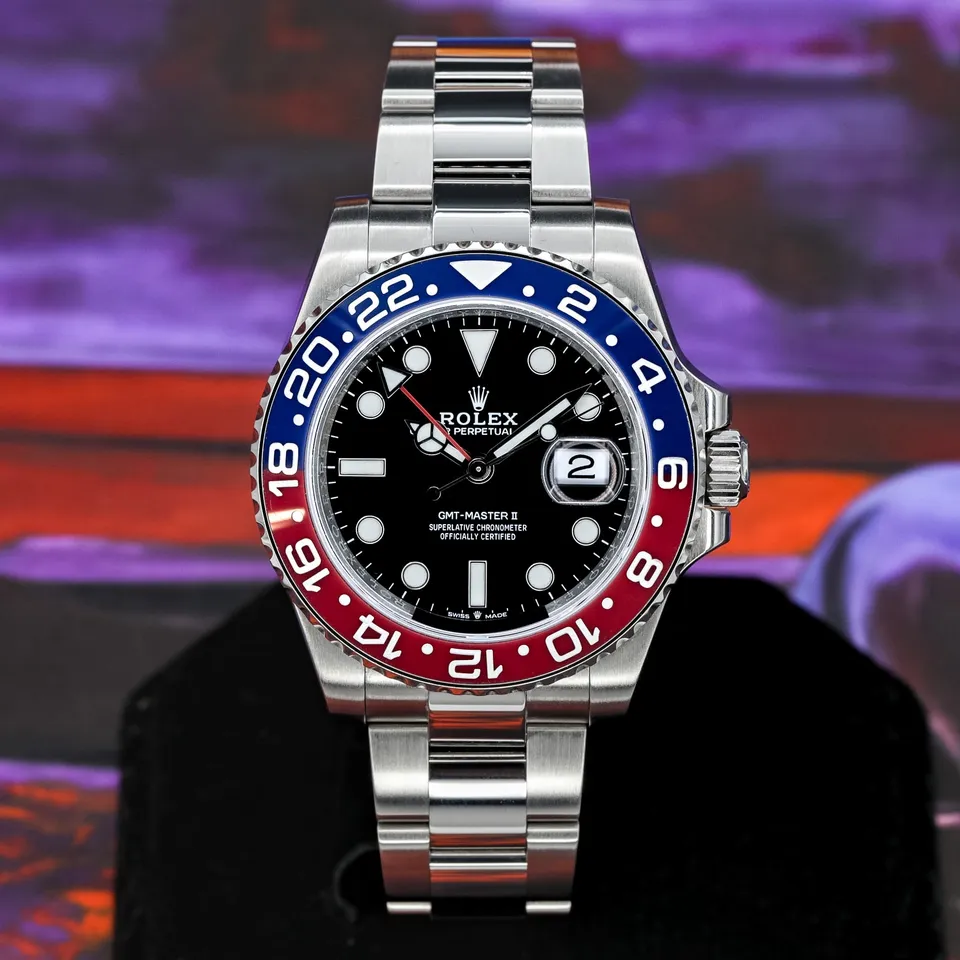
Quick answer: Rolex officially discontinued the GMT-Master II "Pepsi" — steel references 126710BLRO (Oyster and Jubilee) and white gold 126719BLRO — at Watches & Wonders Geneva on April 14, 2026, with no replacement announced. Secondary market prices for the 126710BLRO now range from $28,000 to $45,000+ depending on bracelet configuration and condition, up from an $11,800 retail price. Whether to hold or sell depends on which of four distinct configurations you own: an unworn Jubilee full-set commands top dollar now, while the case for holding a worn Jubilee with complete papers is structural.
The market knew before Rolex said anything. WatchCharts data shows the 126710BLRO was up 19.2% in the 12 months before April 14, and median time on market in March 2026 was 16 days. Sophisticated sellers were moving inventory in Q1. What the official confirmation did was close the last exit for buyers still telling themselves retail was an option — and turbocharged a spread that already existed between condition tiers.
Why the 126710BLRO trades as four different watches, not one
Post-discontinuation, the 126710BLRO trades as four distinct items:
Configuration | Condition | Secondary Range (April 2026) |
|---|---|---|
Jubilee, stickers on, full set | Unworn | $42,000–$45,000+ |
Oyster, full set | Unworn | ~$38,000–$42,000 |
Jubilee, complete papers | Worn, excellent | $32,000–$38,000 |
Oyster, papers only or incomplete | Worn | ~$28,000–$32,000 |
The gap between category one and category four is $13,000–$17,000 on the same reference number. That spread existed before April 14. The discontinuation confirmation amplified it.
The Jubilee bracelet arrived in 2018 and was immediately treated as the definitive configuration. On a watch that ran 13 years in production (2013–2026), the Jubilee closes that era. Its premium over the Oyster has widened since the announcement and is unlikely to narrow.
One note on the unworn premium: stickers-on is a time-decaying story. Every month the watch stays in the box, the "unworn" narrative gets harder to sustain against a growing universe of broken-in examples. If you're holding an unworn full-set and your plan is to sell into the pop, that window does not stay open indefinitely.
What comparable discontinuations predict for 126710BLRO prices
The cleanest precedent is the Submariner 116610LN transition in 2020 — the 40mm was discontinued when the 41mm 126610LN launched. The 116610LN spiked at announcement and gave back roughly 60–70% of that pop over 12–18 months before stabilizing approximately 15–25% above its pre-discontinuation level. The critical difference: the 126610LN absorbed buyer demand. The Pepsi has no successor.
Rolex's own volume discipline reinforces this. Unit output declined approximately 2% to roughly 1.1 million units in 2025, the second consecutive annual decline, per Morgan Stanley/LuxeConsult's 9th Annual Swiss Watcher Report (February 2026). A brand running explicit scarcity management does not discontinue a high-demand reference and immediately replace it. The red/blue colorway has been in continuous Rolex production for over 50 years. Its absence from the steel catalog is a categorical gap, not a rotation.
As of May 2026, the steel GMT-Master II lineup is the 126710BLNR and the 126710BLGR. No red bezel. That is new.
Morgan Stanley/LuxeConsult also notes that Rolex is rationalizing its authorized dealer network from approximately 1,360 retailers toward 800–1,000. If a red-bezel successor arrives in two or three years, there are fewer allocation pathways than there were when the 126710BLRO launched in 2013. The re-entry point compresses structurally.
How to make the hold/sell decision on your specific Pepsi
The announcement-pop contains a liquidity component that will partially mean-revert. Non-collector buyers chasing the news will flip back into the market over the next several months. Asking-price supply on Chrono24 will compress before clearing prices stabilize — the ask side typically leads the move by four to eight weeks.
What should not mean-revert: the floor on a worn Jubilee with complete papers, held by someone who does not need to sell. The no-successor structure, combined with a bifurcating secondary market where Morgan Stanley/LuxeConsult places watches over CHF 50,000 at 89% of 2025's industry growth despite being 1.4% of unit volume, argues for a floor that sits materially above the pre-2026 baseline.
The white gold 126719BLRO is a separate decision entirely. Lower liquidity, wider bid/ask, different buyer. Post-April 14 secondary pricing on that reference is still settling — check Chrono24 and WatchCharts before acting on it.
Hold if: you have a complete Jubilee set in excellent condition and no liquidity need. The structural case for a higher floor is real.
Sell if: you're holding an unworn example and the sticker premium is the thesis. That premium decays.
Rennwrist sources and vets both configurations — see how Rennwrist approaches the private market for collectors. Request access.
Frequently asked questions
Did Rolex discontinue all Pepsi GMT-Master II references, or just the steel one? Rolex discontinued all three Pepsi references at Watches & Wonders Geneva on April 14, 2026: the steel 126710BLRO on both the Oyster and Jubilee bracelet, and the white gold 126719BLRO. No replacement reference was announced for any of them. For the first time in the ceramic bezel era, the steel Rolex GMT-Master II catalog contains no red bezel at all.
How much does bracelet choice affect the 126710BLRO's resale value after discontinuation? Significantly. As of April 2026, an unworn 126710BLRO on the Jubilee bracelet with a full set trades at $42,000–$45,000+, while the equivalent Oyster configuration fetches approximately $38,000–$42,000 — a spread of roughly $3,000–$4,000 for bracelet alone. For worn examples, the Jubilee with complete papers commands $32,000–$38,000 versus $28,000–$32,000 for an Oyster with incomplete documentation. Bracelet and completeness together can account for a $13,000–$17,000 difference on the same reference number.
Is the 126710BLRO price spike likely to hold, or will it correct after the announcement? The announcement-driven pop contains a speculative component that will partially mean-revert as short-term buyers exit. The Submariner 116610LN precedent from 2020 shows a 60–70% pullback from the announcement spike before stabilization 15–25% above the pre-discontinuation baseline. The 126710BLRO's situation is structurally stronger because Rolex has announced no successor — the red/blue bezel combination is simply absent from the steel lineup. A complete Jubilee held without a liquidity need is positioned for a higher long-term floor; an unworn example held for the sticker premium faces a time-decaying window.